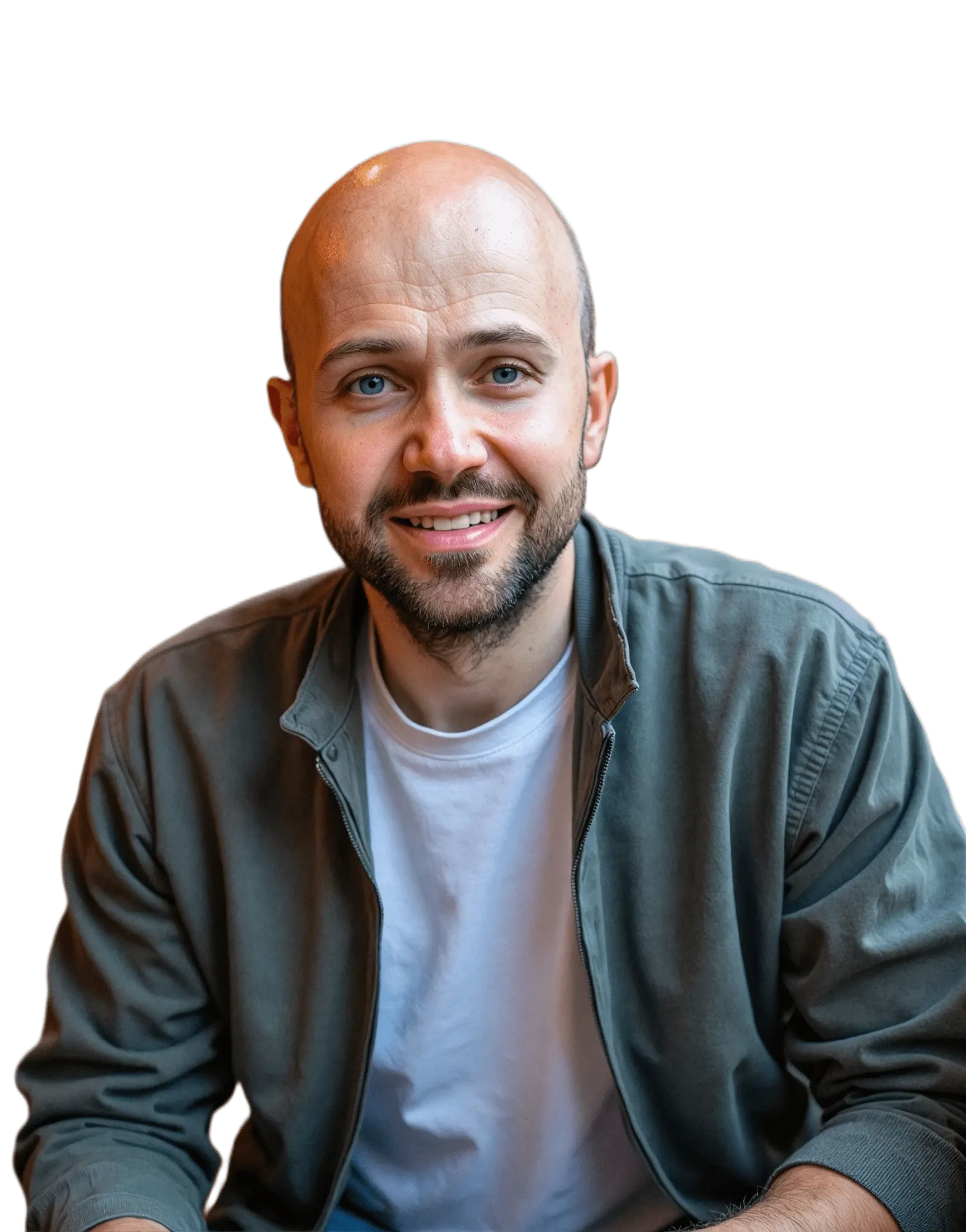
Why German Business Buddy exists
It started with my wife. She came here from Mexico to do her master's at a German
university, and by 2020 she had the degree, two strong internships behind her and real
expertise in her field. That year she wanted a full-time job in that field. She applied,
and applied, and either got a rejection or heard nothing back at all.
I remember her at our dining table, asking what the point of all that education was if
nobody would give her a chance. Instead of working on sustainable development, which is what
she had trained for, she was stocking shelves in a supermarket.
I had spent years working inside German organisations, and I was fairly sure the same
organisations rejecting her applications would happily pay her as a freelancer. German
hiring managers are cautious about putting someone from abroad on a permanent contract, and
far more relaxed about bringing in that same person for a project. You cannot be expected to
know that when you have just arrived. It changes everything.
So she registered as a freelance consultant and we worked through the whole setup together.
It was not easy. Through her network and public tenders she went on to win projects with
a German development agency, a research institute and a UN organisation. Every
registration, contract, price and proposal along the way, we did side by side. After her
first big project finished, she told me:
I would never have done this without you by my side.
Here was someone brilliant who simply needed a guide through a system built to be
complicated. Then other international professionals around me started asking the same
questions: how to register, how the German system works, how to find clients. At some point
it was obvious that this was bigger than my wife and my friends. That is why German Business
Buddy exists.
Self-employment is a real way out. It turns the thing that felt like a disadvantage, being
from somewhere else, into a position in the market that nobody local can copy. The catch is
that going independent in Germany means registering correctly, understanding your tax
obligations, invoicing properly and keeping records that survive scrutiny. That is where
most people stall.
So the work covers three things that are usually sold separately. What you sell and to
whom. How you find clients and get them to say yes, which is the part most people
underestimate. And the administrative side: the forms, the taxes, the deadlines. A
registered business without clients is not a business, and a full order book you cannot
invoice correctly is not one either.
Marketing and client acquisition are where I spend a lot of the time. Most of the people I
work with are excellent at what they do and have never had to sell it, because an employer
always brought the work to them. That is exactly why they hire me.
My background
I hold two bachelor's degrees, a Bachelor of Laws in business law and a Bachelor of Arts
with Honours in Business Management with Law, plus a master's in management and
entrepreneurship with a focus on business development. Before this I worked in management
consulting and business development in international environments.
That mix is the reason this works. The law side means I can read a German regulation and tell
you what it actually requires. The business development side means I can tell you whether
your offer will sell. Working internationally means I know what it is like to operate in a
system that was not designed with you in mind.
One more piece of that mix: I spent six years in Mercury Toastmasters Berlin, an
English-speaking club, where I served as vice president of education and later as club
president. Everything I do with clients happens in English. That is where I practised
doing it well.
I grew up in the Magdeburger Börde, farmland in Saxony-Anhalt, and knew as a teenager that I
would not be staying. I studied business law at Osnabrück University of Applied Sciences,
then won a scholarship for a double degree at Edinburgh Napier University in Scotland.
That year abroad turned out to be the hinge of everything that followed. My English, my
sense of how differently a country can organise itself, and the realisation that I work
best across cultures rather than inside one.
The master's at Leuphana University Lüneburg came next, with a semester in Wrocław, then
management consulting, including a project in Indonesia. From 2009 to 2016 I had an on-off
relationship with Berlin. An internship in the summer of 2009; back in 2010 for a second
internship and my bachelor thesis; Edinburgh that autumn; commuting between Hannover and
Berlin in 2013 while my first consulting project ran here; Scotland again in late 2014;
back for good in January 2016. Apart from three months living and working in San Diego in
2017, I have been here ever since.
From November 2016 to April 2023 I was a business development manager in a group of
companies developing pharmaceuticals and medical devices, and from July 2020 to December
2022 an appointed managing director of one of them, ImmunoLogik GmbH. Carrying the legal
responsibility for a company, rather than advising one from the outside, changes how you
look at every decision.
My wife and I have two children. The paperwork of being an international family in Germany
is not a theoretical subject for me.
Why "buddy"
The name is not a marketing invention. As a student in Osnabrück I joined the university's
buddy programme and was paired with two visiting students from Russia, helping them find
their feet in a country that explains very little to newcomers. I did it again in Lüneburg
with a visiting student from Ukraine, and part of my student job at the university there was
preparing the arrival of visiting professors.
Being the person who explains how things work here, to someone who has just arrived, is
something I have done since my own student days. This business is the same thing, with
bigger stakes and better tools.
Who I am when I am not working
People have called me the friendly German, which I will take. I am curious and I like
structure, and I am the person who opens a stack of Wikipedia tabs in the middle of a trip,
because I want to know why the place I am standing in looks the way it does. History gets
me every time.
I have lived in an international Berlin for more than twelve years. My wife is Mexican, my
closest friend here is Indian, and we spend part of every winter with her family in Mexico.
I have sat in the waiting room at the Ausländerbehörde, the immigration office, more often
than I would have chosen to. Let me be straight about what that does and does not make me.
I am German. This system was built for me, and I have not been through what you are going
through. What I have done is stand next to people who were, for twelve years. That is the
job: I am the local who already knows where the doors are.
And mole. My wife's family makes it, and it manages to be chocolate and dinner at the same
time, which takes care of two of my weaknesses at once.
I hesitated too, for years
This is the part of my own story that most resembles yours, so I would rather say it than
leave it out. For years I knew I wanted to work with international professionals and did
nothing about it, because I did not believe in myself enough. This is my second time working
for myself, and it only happened after I sat in a coaching myself to get clear on what the
idea actually was. I needed someone outside my own head to see it.
So when you tell me you are not sure your idea is good enough, you will not get a
motivational speech from me. I know that loop from the inside.
One more admission: showing myself in public, writing a page like this one, posting,
marketing, is still uncomfortable. I grew up somewhere that did not encourage it. I do it
anyway, because the work matters more than my discomfort. If that is your sticking point
too, it can be learned. I am the slow proof of that.
How I work
One-to-one business mentoring. Not a course, not a template pack. Me alongside you as your
German Business Buddy, working on your actual business and your actual paperwork.
We start with a conversation about where you are and what you want to build. From there we
agree the scope together. When I have capacity, onboarding usually starts within a week.